Furnace Inspection Checklist: Prepping Your Heating System for a New Hampshire Winter
A complete furnace inspection checklist helps property owners verify heating safety, inspect air filters, and confirm proper burner operation before winter arrives. Total Climate Control provides comprehensive heating, cooling, plumbing, and electrical services across Boscawen and surrounding New Hampshire communities. Centralized dispatch in Penacook coordinates diagnostic field visits throughout the region.
Winter weather in New England places extreme mechanical demands on residential heating equipment. Temperatures regularly dip into single digits, forcing systems to run continuous heating cycles for days. Following an orderly furnace inspection checklist protects your equipment from sudden mid-winter failures. This technical guide outlines the physical checks property owners can safely perform, details the diagnostic benchmarks licensed technicians measure during an annual tune-up, and explains how scheduled maintenance protects heating efficiency.
Homeowner Furnace Checklist: Practical Steps Before Ignition
Learning how to prep a furnace for winter begins with checking physical components around the cabinet. Following a structured homeowner furnace checklist ensures that simple airflow and vent problems are caught early. These initial visual checks require no specialized diagnostic instruments.
Inspecting 1-Inch Air Filters and Return Grilles
A clean filter maintains the steady airflow that modern heating equipment requires to function properly. Standard 1-inch disposable filters should be inspected every 30 days during active heating months. Replace pleated media whenever surface dust restricts visibility through the pleats. Dirty filters raise static pressure across the blower assembly. This restriction causes the heat exchanger to overheat and trips the high-limit safety control. Property owners should also confirm that return air grilles and supply registers remain unobstructed by furniture, rugs, or drapes.
Checking Flue Pipes and Exterior Exhaust Terminations
Combustion gases must vent directly outside the home without restriction. Visible metal flue pipes on standard-efficiency units should be checked for rust perforations, loose joints, or soot deposits. High-efficiency condensing furnaces vent through PVC or polypropylene piping. Property owners must ensure exterior intake and exhaust terminations remain elevated above snow drifts. Vent terminations must stay clear of fallen leaves, ice buildup, and bird nests. Manufacturer instructions typically require horizontal PVC vent runs to slope at least 1/4 inch per foot back toward the furnace so corrosive condensate drains.
Clearing Workspace Around the Cabinet
The area surrounding the furnace must remain tidy and free of combustible materials. Flammable liquids, paint cans, cardboard boxes, and laundry piles must be stored far away from the burner compartment. Mechanical codes and manufacturer instructions typically call for at least 30 inches of clear workspace in front of the furnace service access panel. Maintaining open floor clearance also ensures unobstructed combustion air supply for non-direct-vent heating systems.
Professional Furnace Inspection Checklist: Technical Diagnostic Standards
Knowing the benchmarks a licensed technician measures helps you tell a thorough furnace inspection from a quick once-over. Professional diagnostic evaluations follow ANSI/ACCA Standard 4 protocols to assess electrical integrity, combustion efficiency, and mechanical safety.
Manifold Gas Pressure and Burner Combustion
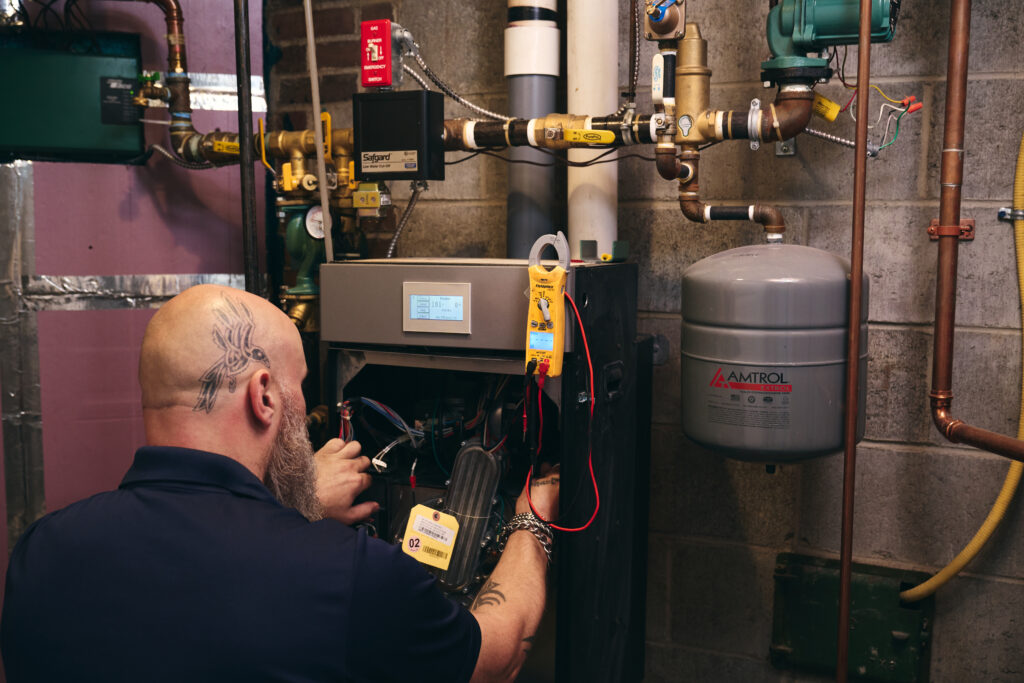
Manifold gas pressure refers to the controlled force of fuel exiting the gas valve into the burner orifices, measured in inches of water column (in. w.c.). Technicians attach a digital manometer to test this pressure against manufacturer specifications. Standard natural gas furnaces typically require 3.5 in. w.c. at the manifold, whereas liquid propane systems operate between 10.0 and 11.0 in. w.c. Incorrect pressure causes uneven burner ignition, soot buildup, and severe thermal stress. Technicians clean burner ports, inspect flame carryover channels, and verify clean blue flame geometry across all burners.
Flame Sensor Microamps and Safety Switches
The flame sensor acts as a safety probe that detects the microamp current generated when flame touches its metal rod. This electrical current, known as flame rectification, confirms ignition to the control board. Technicians measure flame sensor microamps to confirm the reading stays between 1.5 and 4.0 microamps (µA). A reading dropping toward the dropout threshold, which is typically 0.5 to 1.0 µA, causes the board to shut off fuel delivery to prevent unburned gas accumulation. Technicians also test rollout limits, which are thermal safety switches positioned near burner openings. If combustion flames spill outward toward the cabinet instead of drafting into the heat exchanger, rollout limits trip and cut electrical power instantly.
Heat Exchanger Integrity and Airflow Diagnostics
A compromised heat exchanger creates a serious safety hazard by allowing flue gases like carbon monoxide to enter the living space. Technicians inspect combustion chambers for hairline cracks, rust perforations, and thermal fatigue. Flue gas analysis confirms that carbon monoxide levels remain below 100 parts per million (ppm) air-free. Technicians also evaluate temperature rise by comparing return and supply plenum temperatures against the nameplate range, which commonly spans 35°F to 65°F. For complex diagnostic evaluations and furnace repair, local residents rely on trained technicians to maintain safe operation across Boscawen and NH Seacoast properties. Technicians can also inspect related comprehensive HVAC services to ensure ductwork delivers balanced airflow.
Evaluating the Cost-Benefit Trade-Offs of Annual Furnace Maintenance
Before you schedule annual furnace maintenance, consider your system’s age and repair history. Regular tune-ups reduce wear, protect safety controls, and keep fuel efficiency up, but the value of each visit shifts as the furnace gets older.
Reducing Mechanical Wear During Continuous Cold Snaps
Seasonal tune-ups inspect mechanical assemblies that face high wear during New England cold snaps. Technicians test blower motor run capacitors with a digital meter. Capacitors must read within plus or minus 5% to 10% of their labeled microfarad (µF) rating. Weak capacitors cause motors to draw excessive amperage, leading to premature motor winding burnout. Technicians also lubricate motor bearings where applicable, tighten loose electrical terminals, and clear dust from the blower wheel blades. A clean blower wheel maintains proper air velocity across the heat exchanger, preventing high-temperature limit lockouts.
Maintaining Safe Operation and Fuel Efficiency
Calibrating the fuel-to-air mixture and cleaning burner orifices restores combustion efficiency to factory standards. Dirty burners and restricted air passages can steadily degrade seasonal operating efficiency. In addition, testing draft inducer motor pressure switches ensures the venting assembly creates adequate negative draft pressure before fuel enters the combustion chamber.
Balancing Inspection Costs by Furnace Age
Annual professional maintenance is essential, but its economic focus changes as equipment ages. On newer furnaces under 5 years old, major component failures are relatively rare. However, equipment manufacturers typically require documented annual professional service to keep factory parts warranties active. Skipping annual maintenance can void warranty coverage on expensive parts like variable-speed blower motors or circuit boards. Conversely, for furnaces operating beyond 12 to 15 years, property owners must weigh annual repair costs against replacement value. An aging furnace that requires major mechanical overhauls may be a candidate for equipment replacement rather than continued maintenance investments.
Equipment Age and Warranty Verification Guidelines
A furnace inspection checklist works best when you use it every year and track how your system changes over time. On furnaces under five years old, annual service mainly protects the manufacturer’s parts warranty and keeps condensate drain lines clear. Between six and twelve years, parts like blower capacitors, hot surface igniters, and inducer fans start to wear, so replacing them during fall service helps prevent mid-winter outages. Past twelve years, technicians look closely for heat exchanger cracks. If they find serious wear or parts are no longer available, it may be time to compare hydronic heating and boiler systems or high-efficiency heat pumps.
Start Today
Professional Heating Support and Diagnostic Services
Total Climate Control has serviced residential heating, cooling, plumbing, and electrical systems since 2008, with technicians dispatched from Penacook, NH, to Boscawen and surrounding communities. Schedule your furnace inspection early in the fall so there’s time to replace worn parts before the first cold snap. Request an appointment through our online consultation form and get upfront pricing.